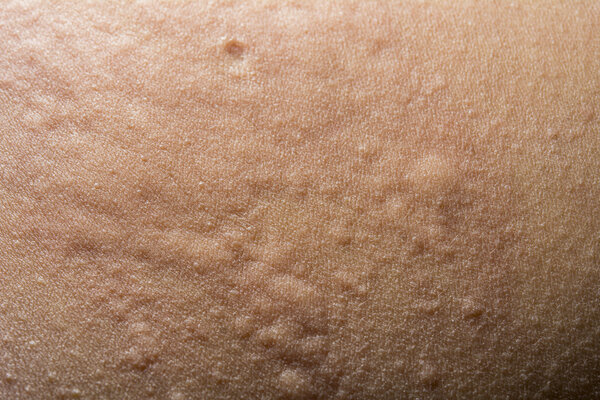
Urticaria, commonly known as hives, is a common skin condition caused by various factors that lead to temporary inflammatory hyperemia and excessive fluid exudation in the blood vessels of the skin and mucous membranes, resulting in localized edematous lesions. It is characterized by rapid onset and resolution, intense itching, and may be accompanied by fever, abdominal pain, diarrhea, or other systemic symptoms. Urticaria can be classified into acute urticaria, chronic urticaria, angioedema, and papular urticaria, among others.
Acute urticaria has a rapid onset, with sudden itching of the skin followed by the rapid appearance of bright red or pale wheals of varying sizes and shapes, which may be isolated, scattered, or merge into patches. Within hours, the edema subsides, and the wheals turn into erythema and gradually disappear, but new wheals continue to appear in succession. Some patients experience gastrointestinal mucosa involvement, leading to abdominal pain and diarrhea. If urticaria affects the respiratory mucosa, it can cause difficulty breathing or even suffocation; in severe cases, anaphylactic shock may occur.
Differential diagnosis of urticaria
I. Differentiation from infantile eczema
Infantile eczema refers to skin lesions with eczema-like characteristics that occur during infancy. Infantile eczema can include infantile atopic dermatitis, but atopic dermatitis is not equivalent to or a substitute for infantile eczema. Infantile eczema includes infantile contact dermatitis; seborrheic and intertriginous infantile eczema; and infantile atopic dermatitis.
II. Differential diagnosis from angioedema
Angioedema is a chronic, recurrent, large-area localized edema in the deep dermis and subcutaneous tissue. Its etiology and pathogenesis are the same as urticaria, except that plasma leaks from the intercellular spaces of small blood vessels in the deep dermis or subcutaneous tissue into the surrounding loose tissue.
III. Differential diagnosis from gastroenteritis and certain acute abdominal conditions.
Urticarial vasculitis wheals last for 24–72 hours, accompanied by fever, joint pain, elevated erythrocyte sedimentation rate, and hypocomplementemia. Pathological examination reveals clump-like vasculitis changes. When accompanied by symptoms such as vomiting, diarrhea, and abdominal pain, it should be differentiated from gastroenteritis and certain acute abdominal conditions.