The hottest time of the year is during the "Sanfu" period in midsummer, which is also when the body's Yang energy is at its peak. During the "Sanfu" period, certain internal or external herbal remedies can be used to adjust the body's Yin-Yang balance, which can help some chronic illnesses recover.
Numerous studies have demonstrated that treating winter diseases in summer can achieve an effectiveness rate of up to 90% in preventing and treating illnesses that are prone to occur in winter, such as asthma and chronic bronchitis. Most diseases that are prone to occur in winter are due to a deficiency of Yang energy in the body and an excess of Yin and cold. The "Sanfu" period (the hottest days of summer) is when the body's Yang energy is at its peak; treatment at this time is beneficial in expelling cold from the body, balancing Yin and Yang, and boosting Yang energy.
In recent years, the application of patches has become increasingly recognized by the public. On the first day of each hottest period of summer, there are many patients coming to the hospital to receive patch treatment, and many people have received good short-term or long-term results.
However, applying patches may not be suitable for everyone, such as people with heat syndromes or those allergic to adhesive tape or topical Chinese medicine. Moreover, the long queues at the hospital during the hottest days of summer deter many people from even trying.
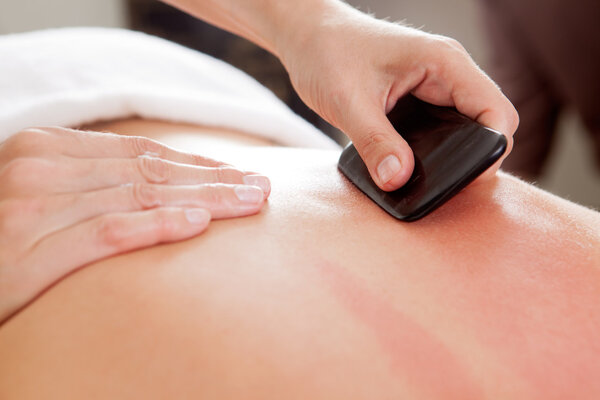
In fact, applying plasters is just one of many traditional Chinese medicine therapies for treating winter diseases in summer. "Treating winter diseases in summer" also includes other external therapies such as acupuncture, moxibustion, scraping, cupping, and massage. Dietary therapy also has this effect.
Below, we will introduce a method of scraping and cupping during the hottest days of summer to prevent and treat lung diseases. This provides a new method besides "Sanfu Patch" that patients can perform at home.
Three steps to solve lung diseases
Step 1: Scrape the back
Focus on the Lung Shu point on the back and perform scraping and cupping in the vicinity.
Each of the five internal organs and six bowels has a "window" on its back, namely the back acupoint. The back acupoint is where the Qi of the five internal organs and six bowels gathers on the back. The acupoint on the back where the Qi of the lungs gathers is the Lung Shu point.
Feishu (BL13) is an acupoint on the Bladder Meridian of Foot Taiyang, and the back-shu point of the Lung. It is located 1.5 cun lateral to the spinous process of the third thoracic vertebra. It is mainly used to treat diseases of the Lung Meridian and respiratory tract, such as pneumonia, bronchitis, and tuberculosis.
Step 2: Scrape the chest
Scrape the entire chest, focusing on the Tanzhong and Zhongfu acupoints, and perform scraping and cupping around them. The reason for scraping the entire chest if there is a lung problem is because, according to the "Sanjiao positioning" method in Traditional Chinese Medicine, both the heart and lungs are located in the chest.
The Tanzhong point is the Qi Hui point among the Eight Hui points. The lungs govern Qi, so if there are problems with the lungs, the Qi Hui point should be selected.
Zhongfu (LU1) is the Mu point of the Lung, and Mu points are acupoints where the Qi of the five Zang-organs and six Fu-organs gathers in the chest and abdomen. Zhongfu is the acupoint where the Qi of the Lung gathers in the chest and abdomen. Zhongfu is located on the lateral side of the chest, 1 cun below Yunmen (LU2), level with the first intercostal space, and 6 cun lateral to the anterior midline. It is indicated for cough, asthma, pulmonary distension, chest pain, and shoulder and back pain.
Step 3: Scrape the arms
Scraping the Lung Meridian of Hand-Taiyin involves scraping the area along the anterior inner edge of both hands where the Lung Meridian runs, with a focus on scraping the section from Chize to Kongzui to Lieque to Taiyuan.
Add three more acupoints if the symptoms are severe.
Generally, lung-related diseases can be resolved using the above three steps. If some symptoms are more pronounced, one or more acupoints can be added to the above three steps to enhance the effect.
Chize (尺泽) is located on the elbow crease, on the radial side of the biceps brachii tendon. It is an acupoint of the Lung Meridian of Hand-Taiyin, and its He-Sea point belongs to the Water element in the Five Elements theory. Chize signifies that the Qi of the Lung Meridian gathers here like water. It is used to treat diseases of the throat, chest, and lungs, such as cough, asthma, sore throat, chest fullness, and vomiting.
Kongzui means "hole" or "aperture," and "zui" means "extreme" or "first." It signifies being the first to open the orifices and has the function of clearing blockages and opening the orifices. This acupoint is located on the line connecting Chize and Taiyuan, 7 cun above the wrist crease. It is the Xi-cleft point of the Lung Meridian of Hand-Taiyin, and has the effects of moistening the lungs, relieving cough and asthma. It is mainly used for lung-related diseases, treating cough, asthma, aphonia, sore throat, headache, and hemorrhoids, especially cough and asthma. Using this acupoint alone or in combination with other acupoints is particularly effective for asthma, especially allergic asthma. Scraping, acupressure, and cupping can all be used at this point.
Lieque (列缺) means "dissection" or "fracture," and "que" refers to a notch or gap. This acupoint is located at the notch or gap of the radial styloid process on the wrist, hence its name. It lies 1.5 cun above the wrist crease, above the radial styloid process. It is the Luo-connecting point of the Lung Meridian of Hand-Taiyin, and since one Luo-connecting point can connect two meridians, this acupoint can treat not only lung-related diseases in Traditional Chinese Medicine but also diseases of the Large Intestine Meridian of Hand-Yangming. Because the Lung and Large Intestine are internally and externally related, and the Lung and Large Intestine Meridians of Hand-Taiyin ascend to the head, neck, and face, Lieque, the Luo-connecting point of the Lung Meridian of Hand-Taiyin, is also quite effective in treating migraines, often surpassing the effects of medication.
In other situations, follow these three steps.
In case 1, if the patient is prone to colds and fevers, the Dazhui acupoint can be added to the above three steps. Scraping, cupping (with cupping), and moxibustion can be used to warm and unblock the yang, relieve exterior symptoms and induce sweating, and dispel wind and cold.
In case two, if the patient has obvious symptoms of weakness and recurrent colds, such as weak breathing, low voice, fatigue and weakness, in addition to colds, the Zusanli acupoint can be added to the above three steps. Scraping, cupping (with cupping), and moxibustion can be used to invigorate the middle yang, dredge the meridians, strengthen the spleen and stomach, and support the body's resistance to pathogens.
Scenario 3: If the patient has a cough with a lot of phlegm, the above three steps can be supplemented with cupping at Tian Tu (with cupping) and Feng Long acupoints. Feng Long acupoint belongs to the Stomach Meridian of Foot Yangming. Traditional Chinese medicine believes that the lungs are the receptacle for phlegm, and the stomach is the source of phlegm production. Gua Sha, cupping (with cupping), and moxibustion at Feng Long acupoint can dispel phlegm, clear heat, and promote the flow of lung qi.
Scenario 4: If a patient's asthma persists for a long time, and asthma attacks occur with even slight activity, often accompanied by vigorous movements, such as raising their shoulders and opening their mouth wide to breathe, as if they are struggling to catch their breath, and some patients have a 10- or 20-year history of asthma, this situation is highly likely to be kidney deficiency asthma. Traditional Chinese medicine believes that the kidneys govern the intake of qi, meaning they also participate in respiratory function, and that prolonged illness inevitably affects the kidneys; various diseases can eventually impact the kidneys. If the above situation occurs, the Shenshu (BL23) and Zhongji (CV3) acupoints can be added to the above three steps to tonify the kidneys and strengthen their foundation.
The principle of Gua Sha
Gua sha (scraping therapy) can cause local tissues to become highly congested, and the stimulation of blood vessels and nerves can cause blood vessels to dilate, increase blood and lymph flow, enhance phagocytosis and transport, accelerate the elimination of waste and toxins from the body, nourish tissue cells, thereby purifying the blood, increasing the body's resistance, alleviating the symptoms, and promoting recovery.
Modern medicine believes that the appearance of petechiae during scraping is an autologous hemolytic process. The process of scraping and the appearance of petechiae is a phenomenon in which blood vessels dilate and eventually capillaries rupture, causing blood to spill out and forming ecchymoses on the skin. These blood clots (petechiae) will soon dissipate, thus playing a role in autologous hemolysis and forming a new stimulant that can enhance local metabolism and has an anti-inflammatory effect.
Autologous hemolysis is a mild and benign process that can not only stimulate and regulate the immune system, but also act on the cerebral cortex through afferent nerves, continuing to regulate the excitation and inhibition processes of the brain and the balance of the endocrine system.
Therefore, scraping during the "Sanfu" period, when the body's Yang energy is at its peak, will more easily stimulate Yang energy, thereby helping some chronic illnesses to recover.