Among our readers, it's not hard to find that a large number of people have this idea: to control their weight and lose weight without affecting their normal diet, they don't want to exercise or put in too much effort, but they still hope to avoid gaining weight and lose weight.
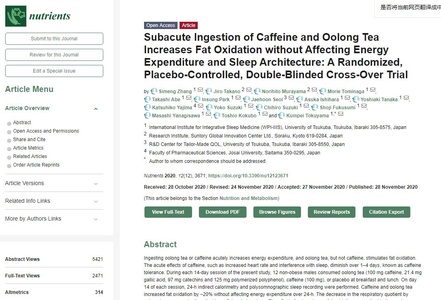
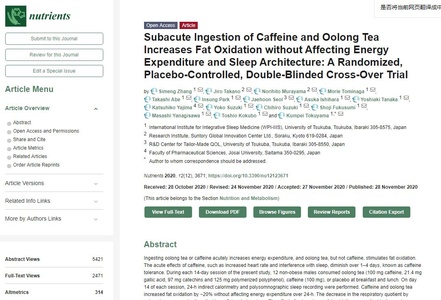
A study by Nutrients suggests that this idea could be realized, even "losing weight while sleeping," by drinking large amounts of oolong tea.
A Japanese research team selected 12 healthy male volunteers aged 20-56 to participate in this oolong tea weight loss experiment. The participants drank two cans of oolong tea daily (350 mL/can; one can for breakfast and one for lunch), and were prohibited from consuming other caffeinated beverages while maintaining their daily activities and dietary habits. After the 14-day trial, researchers found that oolong tea had a certain effect on fat breakdown.
A professor at the International Institute of Integrative Sleep Medicine stated that it is possible to counteract holiday overindulgence by drinking large amounts of oolong tea. The stimulating effect of oolong tea on fat breakdown during sleep may have practical clinical significance for weight control.
Nutrients is only for men? Don't worry, women actually experience better weight loss results from drinking oolong tea than men!
A population intervention experiment showed that among 102 people who were overweight or obese due to improper diet, drinking 8g of oolong tea daily for 6 weeks helped them improve their health.
Among extremely obese individuals, 70% lost 1 kg after drinking tea, and 20% lost more than 3 kg.
In the general obese population and the overweight population, the proportion of people who lost more than 1 kg was 64% and 66%, respectively .
Furthermore, oolong tea is more effective for women's weight loss than for men's.

These studies have given hope to many people who need to lose weight. The dream of "losing weight while sleeping" seems to be about to come true. How much oolong tea should one drink each day to lose weight?
Scientists randomly divided 32 obese rats into 4 groups. The obese control group was given distilled water daily, while the low, medium, and high dose groups were given 0.4 g/kg, 1.2 g/kg, and 2.4 g/kg of oolong tea daily, respectively. After feeding them a high-nutrition diet for 30 days, their body weight and body fat were measured, and the β3-AR mRNA level in adipose tissue was detected by RT-PCR.
The results showed that oolong tea has a certain weight loss effect, which is related to its ability to increase the level of β3-adrenergic receptor AR mRNA in adipose tissue. A moderate dose of 1.2 g/kg may be an appropriate dose.